
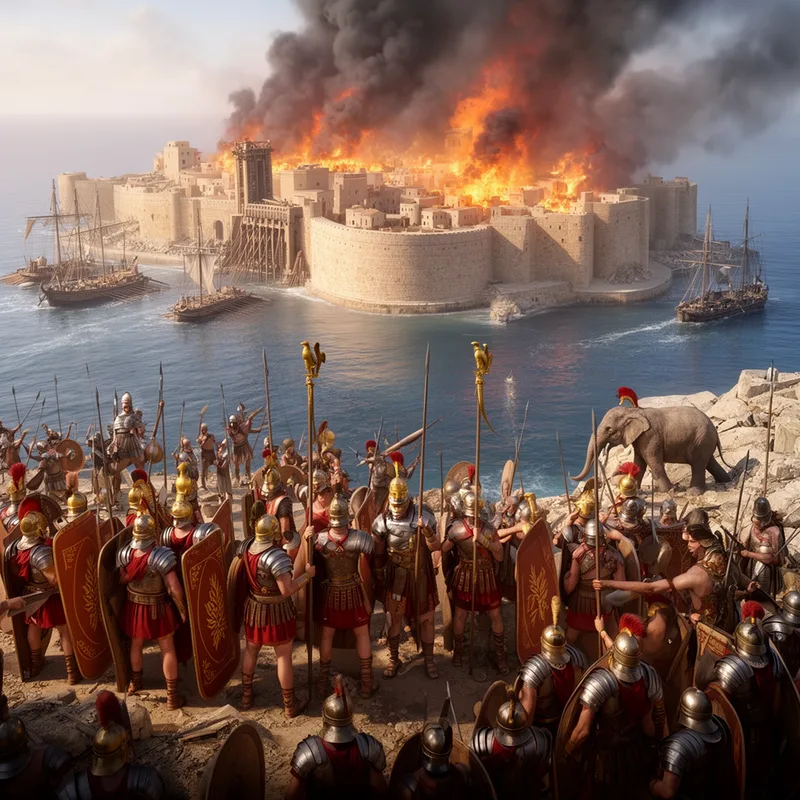
Punic War
 1
9.1

- noun
- /ˈpjuːnɪk wɔr/
- Except for this next example from a rather salty chapter in Roman history, the Punic Wars against Carthage.
- the Second Punic War
- the First Punic War
- Punic War (264-241 BC)
Examples
-
This is clear from Mr. Madden's own recounting of the Punic Wars.
Blog text (26) -
Gone were the days of massed naval battles which had been seen during the Greco Persian Wars, the Punic Wars and the Roman Civil Wars.
-
This was the first Punic War.
Blog text (26) -
In the case of the Punic Wars, and all of Rome's wars, it was violence.
Blog text (26) -
And so, you know, people have pointed out, we do believe the Punic Wars, which described the battles between Carthage and Rome.
-
Thus, we see that throughout the First Punic War, elephants would rack up a mixed record of wins and losses.
-
The Second Punic War saw Hannibal cross the Alps.
Blog text (26) -
During the Second Punic War, Rome got its excuse to intervene in the affairs of Greece and fought number of wars against the heirs of Alexander the Great.
-
After losing a hand in the Second Punic War (218-201 BC), Marcus Sergius, a Roman general, received a prosthesis that enabled him to return successfully to battle.
Academic text (2014) -
The outcome of the Second Punic War was a decisive victory for Rome, which disrupted Carthaginian power in the region.
Surface Forms
Morphology
The phrase is compositionally formed from 'Punic' (relating to Carthage) + 'war' (armed conflict), so a learner who knows both constituents can infer it means a war involving the Punic/Carthaginian people. Although the term is historically specific (referring to three particular wars), the basic semantic relation is directly derivable from the parts.
Etymology
Punic War comes from an old Latin word for the people of Carthage, called the 'Phoenicians'. So Punic War means the wars between Rome and Carthage that ended with Carthage's defeat.